A = A

Axiom: A thing is itself. A = A.

This is not a statement among many. It is the precondition for any statement. To deny the Law of Identity (A = A) to say “a thing is not itself” – requires that the denial mean what it says and not its opposite. The act of denial assumes the identity of the words used. The attempt to reject identity performs identity. The axiom is inescapable.

Identity is the singular, mandatory requirement for existence. To exist is not a property added to a substance, it is the physical manifestation of a fully resolved identity A = A. If a physical configuration is perfectly self-identical, it possesses an absolute truth value and manifest as a coordinate within physical reality. A thing cannot be real without being itself, and it cannot be itself without being real. In the reality we exist, logical consistency is strictly identical to physical existence: the self-identical is mandatory, and the paradoxical is physically impossible.

If A = A is rejected, the rejection is incoherent. No symbol can refer stably to anything, including itself. The processor crashes.

Theorem 1: Absolute Nothingness cannot exist. Therefore, Existence as a whole is mandatory.

Nothingness is defined as the complete absence of all properties, including a definitive identity and the property of existing. For Nothingness to be the case, it must be the case that Nothingness is – it must possess the property of being real. But if it possesses any property, it is not Nothingness. The concept is self‑annihilating.

Furthermore, the very act of questioning, denying, or reasoning about existence is itself an existent act – a structured performance that is. This act is not nothing; it has content, form, and occurrence. Therefore, without any appeal to an indirect logical law, we have direct positive proof that something exists.

Since absolute Nothingness is impossible, and since the act of engagement with this question already demonstrates that something is the case, Existence is the mandatory default. There was never a void. The “whole” simply is.

Because you are reading this, Existence is true and real. Absolute Nothingness is not a valid alternate total possibility to existence. Therefore, existence as a whole is not competing against “nothing” as a real alternative. The whole exists eternally as a default state of reality obeying logical necessity.

To reject Theorem 1 is to claim Nothingness could be real. But the claim itself asserts the reality of Nothingness, which gives it an identity – contradicting its own definition. The rejection is a performative contradiction. The processor crashes.

Deductive Proof of Default Existence →

Theorem 2: The whole is finite. Physical infinity is a logical error.

A physical whole is an extensional totality: its identity is constituted by the actual, determinate constituents that make it up. Unlike an abstract mathematical set, which can be defined intensionally by a rule or a formula (e.g., “the set of all natural numbers”), a physical whole is not a rule. It is the concrete sum of everything that physically exists. Its identity is not given by a logical definition; it is given by the completed collection of all actual physical things.

For an extensional totality to satisfy the Law of Identity (A = A), it must be structurally complete. “Structurally complete” means that the collection of its constituents forms a closed, exhaustive set. There is no further constituent to add; the whole is fully constituted by what it actually contains. An extensional totality that is structurally incomplete is not a determinate whole; it is an open‑ended aggregation that has not yet arrived at a definitive state. Only a structurally complete extensional whole can be this whole and no other.

Now consider an actually infinite physical whole. To be a completed extensional totality, it would have to actually contain infinitely many distinct, determinate physical constituents. But an infinite collection is, by definition, endless. To be “complete,” a collection must have no further member to add; it must be finished. To be “endless” is to have no final member; it is to be intrinsically unfinishable. “Complete” and “endless” are mutually exclusive properties: one asserts closure, the other asserts the absence of closure. To claim that an infinite physical whole is a completed extensional totality is to assert that an endless collection has an end a direct violation of the Law of Non‑Contradiction, which is a direct corollary of the Law of Identity (A = A).

Abstract mathematical sets escape this contradiction because they are not extensional totalities. They are intensional rules. The set of natural numbers is not a completed list of all numbers; it is a definition that generates them. No mathematician claims that the set of natural numbers is a finished enumeration of concrete objects. The identity of an intensional set resides in its defining rule, which is perfectly determinate without requiring the actual completion of an endless sequence. But the physical whole is not a generation rule; it is the actual stuff of reality. If that stuff were infinite, reality would have to be both finished (to be a determinate whole) and unfinished (because infinite). That is impossible.

Therefore, the physical whole cannot be actually infinite. It must be finite: a completed, closed, extensional totality with a definite, specific number of physical constituents, fully determinate and fully self‑identical.

The Bekenstein Bound I ≤ 2πRE / (ℏcln⁡2) independently confirms that any finite physical region has a finite informational capacity. The Planck scale defines a minimum resolvable length, confirming that physical reality is not infinitely divisible. Hilbert’s Hotel paradox demonstrates the logical absurdity of treating an actual infinite as a completed physical entity. These results are not the deductive proof; they are the external verification that the logic is sound.

To reject Theorem 2 is to assert that a physical set can be infinite – lacking a determinate magnitude – and still possess a unique identity, which is a direct A ∧¬ A contradiction. The processor crashes.

Deductive Proof of Finite Whole →

Fallacy of Actual Physical Infinity →
Theorem 3: The whole is a static 4‑dimensional block. No coordinate is ever created or destroyed.

The Identity Constraint (A = A) requires that “the whole” the totality of all that exists be a single, determinate object with a fixed identity. The phrase “the whole” must refer to the same thing at all times, otherwise it fails to pick out a unique referent and the statement “the whole exists” has no stable truth value.

Now consider a dynamic model of time: the past is gone, the future does not yet exist, and only the present is real. In such a model, the whole at t₁​ is W₁​ (the set of all existents at t₁​), and the whole at t₂​ is W₂​ (a different set). Since W₁​ ≠ W₂​, “the whole” does not name a single object; it names a succession of distinct entities. The maximal referent shifts, and the Identity Constraint is violated globally.

Local change within a static block a leaf being green at one coordinate and red at another does not violate A = A, because both coordinates are equally real and permanently fixed within the unchanging 4‑dimensional solid. The leaf’s states are different parts of the same whole, not a change in the whole’s own composition.

To preserve a fixed identity for the whole, every coordinate that is real must be permanently real. No coordinate can be added (there is no external source) and none can be removed (deletion would alter the whole’s identity). Therefore, the whole is a completed, unchanging 4‑dimensional solid containing all spatial and temporal locations simultaneously.

To reject Theorem 3 is to assert that the whole can gain or lose parts while remaining the same whole – a violation of identity. The processor crashes.

Theorem 4: The whole requires no external cause or energy. Its total energy is exactly zero.

Nothingness is impossible (Theorem 1). Therefore, there is no “outside” to the whole from which energy or causation could be drawn. The whole is all that exists. If its total energy were non‑zero, it would possess an unexplained magnitude – a net positive or negative balance with no external referent. A net positive energy would imply a debt to something not contained within the whole. But nothing exists outside the whole.

The only value that requires no external explanation, no outside creditor or source, is zero. The total energy of the whole must be exactly zero. Positive mass‑energy and negative gravitational potential energy must cancel perfectly – not as a contingent coincidence, but as a geometric identity of the self‑contained manifold.

To reject Theorem 4 is to assert that the whole can be indebted to something that does not exist – a contradiction. The processor crashes.

Theorem 5: The whole is a closed temporal loop. The conformal identification suture.

The whole is finite (Theorem 2) and static (Theorem 3). It cannot extend infinitely into a linear future, nor can it terminate at an arbitrary spatial or temporal edge, as an edge implies a boundary where the universe stops and “nothing else” begins – a structural impossibility (Theorem 1).

The only geometric configuration that satisfies a finite, boundaryless, and self-contained manifold is a closed temporal loop. The final phase of the whole – the Heat Death, where all rest-mass has decayed into massless radiation – maps cleanly to the initial phase – the Big Bang, which is also a state of pure, massless radiation.

At both limits, as the scale factor collapses (a → 0), the metric of spacetime loses its clocks and rulers. Without rest-mass to define scale, the localized thermodynamic distinction between “hyper-compressed concentration” and “maximal diffusion” completely vanishes. Through Conformal Scale Invariance, these two states share identical geometric and informational properties.

By the Identity of Indiscernibles, they are the exact same state. The Heat Death and the Big Bang are a singular coordinate (S), evaluated not as a local thermodynamic intersection, but as a global identification space. The End is the Start.

To reject Theorem 5 is to assert that the universe can possess a physical edge where it ceases to exist without encountering an external boundary – a direct violation of identity. The processor crashes.

Theorem 6: The whole is globally non-orientable. A necessary 4D geometry.

The whole must be:

  • Unoriginated (Theorem 1).
  • Finite (Theorem 2).
  • Static (Theorem 3).
  • Self‑contained (Theorem 4).

Theorem 5 establishes that the absolute macro-expansion and the absolute micro-singularity are identified at a singular coordinate state (S).

The thermodynamic arrow of time is defined locally by the vector of the increasing entropy gradient, pointing from lower to higher entropy. If the closed temporal manifold were standard and orientable, a local observer traversing the loop would find that at coordinate (S), the incoming entropy vector from the Heat Death would crash head-on into the outgoing entropy vector of the Big Bang. Forcing a single coordinate to host two opposing local vector properties simultaneously would create a fatal logical fracture A ∧¬ A.

The whole resolves this without local contradiction by utilizing a globally non-orientable topology.

Local tracking of the entropy gradient remains continuously orientable, unbroken, and deterministic at every individual coordinate along the trajectory – fully satisfying A = A locally for all observers. However, across the global suture, the metric transitions through an orientation-reversing diffeomorphism.

State (S) does not superimpose two conflicting local properties; it acts as a global parity-flipping mirror where the maximal expansion naturally becomes the absolute dawn of the next scale-invariant cycle. The global topology twists the coordinate space, allowing the arrow of time to flow endlessly while perfectly preserving the absolute Law of Identity.

To reject Theorem 6 is to claim that a global manifold cannot possess non-orientable fiber bundles, forcing a local contradiction onto a geometric transformation. It asserts an A ∧¬ A paradox where none physically exists. The processor crashes.

Conclusion: The whole is an unique topology – The 4D Klein Block

The 4D Klein Block is the unique geometric shape that satisfies all the constraints established by Theorems 1 – 6:

  • Unoriginated (Theorem 1)
  • Finite (Theorem 2)
  • Static (Theorem 3)
  • Self‑contained (Theorem 4)
  • Temporally looped (Theorem 5)
  • Globally Non‑orientable (Theorem 6)

The only self-parenting, boundaryless, 4‑dimensional, globally non‑orientable manifold that accommodates all these properties is the 4‑Dimensional Klein Block. Its fundamental group contains the parity‑flipping monodromy that allows the entropy gradient to invert smoothly across the suture, resolving the contradiction while preserving A = A.

No orientable manifold can accomplish this. No infinite manifold can satisfy finitude. No bounded manifold can satisfy sovereignty. The 4D Klein Block is the unique geometric resolution of the equation A = A applied to the maximal whole. Any dimension higher than 4 introduces arbitrary, unforced structure that violates the Principle of Sufficient Reason, itself a corollary of A = A. Four dimensions is the minimum required for the non‑orientable suture and the closed temporal loop; it is therefore the only logically permitted dimensionality.

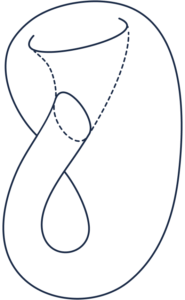
A Klein Block is a 4‑dimensional, non‑orientable topology with no edge, meaning it has only one side and no distinct inside or outside. It loops back inside without ever touching or puncturing the surface. It is its own parent, its own container, and its own verification.

Therefore, the Whole is an Unoriginated, Eternal, Self-contained, and Self-verifying 4D-Klein Block. The Loop is Closed. A = A.

Klein Bottle by Felix Klein (1882)