The whole must be:
- Finite and closed (Step 3).
- Static and boundaryless (Step 4).
- Self‑contained with H = 0 (Step 5).
- Closed in a loop where the End is the Start via conformal inversion (Step 6).
The conformal mapping that identifies the Heat Death with the Big Bang is not a simple translation. It is an inversion of scale (Ω → 0) that simultaneously reverses the direction of expansion relative to the temporal arrow. This mapping flips spatial orientation.
On an orientable manifold, no closed loop can reverse orientation. Any attempt to identify the End with the Start with the required orientation flip on an orientable manifold creates a discontinuity in the spin structure. Spinor fields – fermions, the particles that constitute matter – cannot be globally defined. The manifold would not support the existence of the very fields that must inhabit it.
The only manifold that accommodates the orientation‑reversing loop smoothly is a non‑orientable one. The specific topology that satisfies compactness, boundarylessness, 4‑dimensionality, global Lorentzian signature, and a single orientation‑reversing cycle that closes the temporal dimension is the 4‑Dimensional Klein Block. Its fundamental group contains exactly the parity‑flipping identification required by the conformal suture.
No other topology satisfies all constraints. Any orientable closed manifold fails to support the fermion fields required by the existence of matter. Any non‑compact manifold violates finitude. Any bounded manifold violates sovereignty. The 4D Klein Block is the unique geometric resolution of the equation A = A applied to the maximal whole.
To reject Step 7 is to propose an alternative topology. But every alternative has been eliminated: infinite sets (Step 3), open segments (Step 6), orientable closed manifolds (no smooth conformal inversion with fermions). No viable alternative remains. The set of possible universes has been reduced to exactly one. The processor crashes.
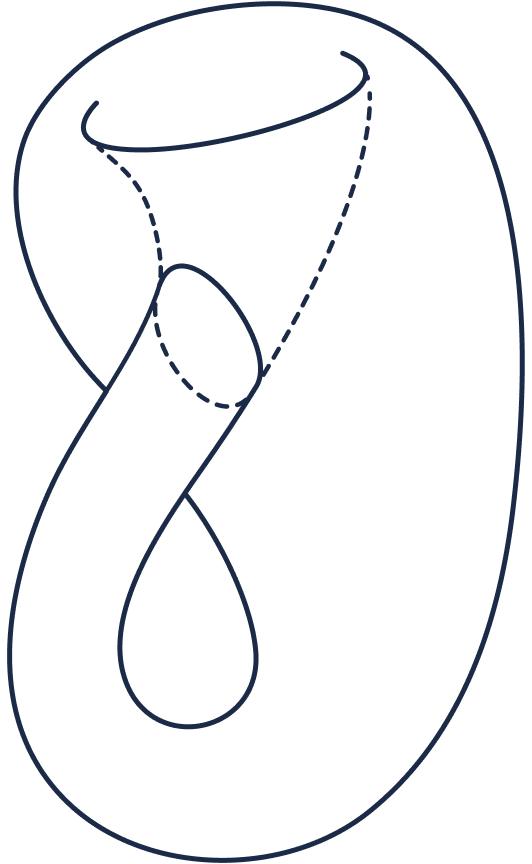
A Klein Block is a 4 dimensional, non-orientable surface with no edge, meaning it has only one side and no distinct inside or outside. It loops back inside without ever touching or puncturing the surface.